Leslie Grief
I'd Like to Apologize to Every Teacher I Ever HadLeslie Grief is the producer friend who transforms Tony Danza’s uncertain plan to become a teacher into Teach, while continually testing the limits of what a classroom reality show may ethically do. He sees the commercial possibility in Danza’s third-act career before Danza does, sells the idea to A&E with remarkable speed, and then clashes with Danza over whether students’ real lives should be observed or manipulated for television. Grief’s importance lies in that contradiction: he helps create a project intended to illuminate public education, yet repeatedly treats dramatic conflict as the condition of its survival.
Identity and Introduction
Leslie Grief enters as a longtime producer with a record of reality-television success. When Danza tells the executive producer of his former talk show that he is considering giving up acting to become a teacher, the producer immediately suggests making the transition a reality show. Danza initially rejects the idea because he wants to teach rather than combine teaching with show business, and because the proposed program would involve actual students and their actual education. Grief, however, makes the same suggestion a few weeks later. Danza describes him as a producer with a string of reality-TV hits, someone whose instinct is to recognize a marketable premise almost instantly.
Grief’s confidence is established through a wager. Danza tells him that even if a teaching program could be made, it would never be sold to a network. Before ending the call, Grief bets that he can sell it within half an hour. Twenty minutes later, he calls back to announce that a meeting with A&E has been arranged for the following week to discuss Danza’s new show about teaching. The episode presents Grief as a person whose promotional energy converts hesitation into obligation: once he has made the idea public and placed it before a network, Danza can no longer retreat easily from the commitment.
Building the Project
Grief is the driving salesman at the meeting with three A&E executives at Sparks Steak House in New York. While Danza remembers the restaurant’s association with a Mafia hit and dislikes the setting for a lunch meeting, Grief is already operating at full promotional force. Danza compares him to the reincarnation of P. T. Barnum, emphasizing his instinct for spectacle, persuasion, and momentum. Grief frames education as an urgent national subject, arguing that presidential candidates continually promise to become the “Education President” while the problems of American schools continue to worsen.
His sales pitch does not reduce the program entirely to entertainment. Grief also argues that the show could present what teachers confront in public school systems and what students are, and are not, receiving from those schools. Danza imagines a possible benefit for students, teachers, the network, and himself, including the possibility of inspiring other people to enter teaching. Grief therefore helps attach a civic purpose to the commercial project. Yet his method remains fundamentally promotional: the show must be made attractive to a network before its educational aims can matter.
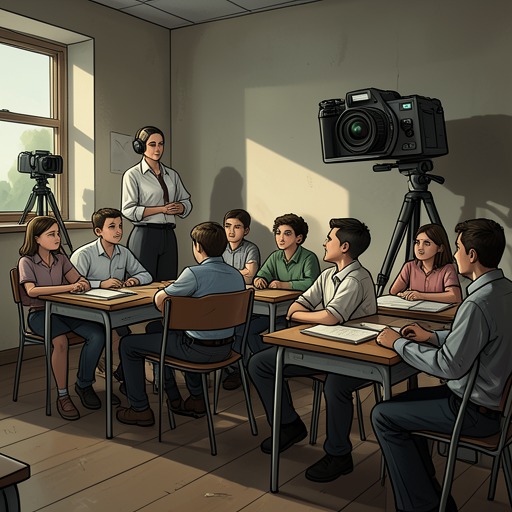
The central terms of the project are established when Danza interrupts Grief’s momentum to state his conditions. Danza rejects the standard reality-television practice of soft scripting, in which producers devise a storyline and then induce people to make it happen while calling the result reality. He insists that the students come first, that the program be filmed like a documentary, and that the cameras record what happens rather than force fake drama. Grief allows this vision to be presented, but his later conduct shows how unstable that agreement is. The project’s founding tension is already visible: Danza treats authenticity and student welfare as nonnegotiable, while Grief must persuade a network that unmanufactured classroom life will be sufficiently dramatic to hold an audience.
Conflict over Drama and Reality
The conflict becomes explicit after the class’s trip to Washington, D.C. Danza sees the day as a success because the students are learning, engaged, and enjoying themselves. Grief calls the next day to say that the program has “a boring show” and that Danza had “nothing” in the footage. When Danza protests that Washington was beautiful and that the students loved the experience, Grief replies that nothing happened and says that they will have to start setting things up if Danza expects to have a watchable program.
Danza recognizes “setting things up” as a code for rigging the program, manipulating the storyline, and manipulating the students. He refuses, even when Grief suggests that the network may cancel the project immediately. The disagreement is not simply a quarrel between an artist and an executive over taste. It places two definitions of value against each other. For Danza, ordinary educational success is itself meaningful material; for Grief, a trip without visible conflict is unusable television. The more responsibly the students behave, the less valuable their day becomes within the production logic Grief represents.
The financial stakes sharpen the pressure. After another uneventful day, Grief reminds Danza that chartering the bus, buying theater tickets, paying overtime, and taking out extra insurance were expensive. Something, he insists, was supposed to happen. He warns that the network may pull the plug because the cameras missed Danza’s confrontations with Al G and Matt and the other students were too well behaved, having too good a time. Danza’s first response is relief rather than fear. He is tired of being miked and filmed, and he increasingly believes that the kind of drama the network wants is precisely what his students and he do not need.
Grief’s position is most revealing in the production’s treatment of David Cohn. The show runner, hired with Danza’s participation, begins pushing the program toward heightened conflict. During a filmed review of Danza’s teaching, the director asks David and Danza to walk down a hallway instead of conducting the evaluation in David’s office, where David would normally work. While the cameras are recording, the director makes stabbing motions to urge David to criticize Danza more aggressively. David refuses to act and later threatens to leave if the production does not stop pressuring him. Danza confronts Grief and manages to keep David involved, but the incident permanently changes the atmosphere: every administrative summons or student crisis becomes suspect, because Danza can no longer be certain that the production team has not nudged it into existence.
Decline, Publicity, and the End of Filming
At the end of January, Grief’s warning becomes reality. A&E decides that the roughly six one-hour episodes already filmed are enough. The crew will return for limited pickup footage and interviews, but the principal filming is over. The decision confirms Grief’s commercial judgment that the available material has reached the network’s threshold, while leaving Danza to face the school year without the cameras that had made his authority feel both exposed and supported.
The end of production does not end Grief’s influence. At the wrap party, held in an art deco bowling alley near Danza’s apartment, the production team attempts to present the first episode to students, parents, and teachers. The noise of bowling repeatedly drowns out the speeches and screening, creating what Danza sees as an unintended metaphor for the entire project: the surrounding spectacle overwhelms the event meant to communicate something important. Grief is present in the larger structure of this celebration, even though the central conflict has shifted from making the series to controlling how its failure or limitation is understood.
Later, the network’s silence about an airdate produces another publicity crisis. Because the project cannot be discussed with the press, the Northeast Times portrays the silence as a sinister conspiracy and asks why Tony Danza will not talk. Grief calls Danza with the news that The Philadelphia Inquirer will send an education reporter and photographer to interview him and observe his class. Danza experiences the shift from total blackout to sudden classroom invasion as a form of whiplash, but Grief warns that resisting would make the newspaper conclude that Danza has something to hide. His approach again treats publicity as a strategic necessity, even when it threatens to turn the classroom into another managed media event.
The Final Confrontation and Legacy
Grief’s most intimate confrontation with Danza occurs during the last week of school. The crew must film two additional days in case the network orders more episodes, including commencement and a classroom goodbye. Because most students are expected to skip the final days, Grief wants Danza to pretend that school has ended and say farewell early. Danza rejects the request because the school week is not over and he will not fake a goodbye. When Grief asks what the crew is there for, Danza answers that he does not know and does not care. The students watch the exchange as a family feud, and Grief storms out while the cameras continue rolling.
The confrontation exposes the limit of Grief’s power over the material. He can demand a scene, schedule a farewell, and frame the practical reasons for filming, but he cannot make Danza experience the ending on cue. Danza’s eventual breakdown comes not from a manufactured plot point but from the genuine recognition that he is going to miss the students. He cries, tells them how much he loves them and how they have changed his life, and is gathered into a group hug in which even Al G comes close. The emotional scene gives Grief the goodbye he wanted, but only after the attempt to stage it has failed. Its force comes from the reversal: authentic feeling defeats the production timetable.
After Teach finally premieres on October 1, 2010, A&E broadcasts it for six weeks in a late Friday-night slot. Danza hopes viewers will gain a profound appreciation for the challenge teachers face, even if his classroom meltdowns dramatize that challenge. He also feels that the abruptly canceled series has missed a golden opportunity and that the group hug at the end of the year, which might have provided a conclusion, never aired. Grief’s role therefore extends beyond the scenes in which he argues for conflict. His production logic helps create the incomplete ending that leaves Danza’s educational experience without the closure its real participants felt they had earned.
The book nevertheless credits Grief with getting Teach made. Danza thanks him, along with A&E and its executives, and acknowledges that the project could not have existed without the producer’s persistence and salesmanship. Grief is thus neither a simple villain nor a neutral facilitator. He is the force that opens the door to the school, the pressure that repeatedly threatens the students’ priority, and the professional counterpart against whom Danza defines responsible reality. Their relationship gives the project its governing question: whether television can represent education without making education subordinate to television’s appetite for conflict.